" height="9.657857142857143px" id="pympMZ9U_" transform="translate(0 5)" width="19.315714285714307px"/><path d="M 0.297 0.904 C 0.026 1.263 0.027 1.678 0 2.02 L 1.348 1.221 L 1.916 1.556 C 1.875 1.969 1.948 3.046 2.575 4.043 C 3.359 5.29 5.176 5.528 6.594 4.792 C 7.628 4.255 7.276 2.448 8.414 2.383 C 8.7 2.443 9.022 2.471 9.093 2.699 C 9.181 2.983 9.281 4.727 10.249 5.075 C 11.447 5.507 11.907 5.716 13.604 5.27 C 14.042 5.036 14.328 4.803 14.588 4.463 C 15.123 3.762 14.99 3.131 14.957 2.537 C 15.296 2.074 15.23 1.659 14.842 1.451 C 14.454 1.244 12.248 0.412 10.626 0.707 C 10.089 0.804 9.54 1.349 9.1 1.348 C 8.659 1.346 8.837 1.354 8.003 0.73 C 7.168 0.106 3.242 0.298 2.119 0.134 C 2.119 0.134 1.91 -0.027 1.713 0.004 C 1.497 0.038 1.463 0.161 1.226 0.324 C 0.988 0.488 0.555 0.562 0.297 0.904 Z" fill="rgb(28, 28, 28)" height="5.518765311121538px" id="cG4AuZKJW" transform="translate(2.07 7.069)" width="15.176623979657048px"/><path d="M 0.169 0.73 C 0.056 0.862 0.009 1.291 0 1.489 L 1.285 0.622 L 1.229 0 C 0.922 0.188 0.281 0.598 0.169 0.73 Z" fill="rgb(255, 255, 255)" height="1.4891214285714285px" id="JXtMUc_ci" transform="translate(2.159 7.467)" width="1.2851357142857216px"/></svg>)
" height="15.00002px" id="xZbdZovFb" transform="translate(4.168 3.334)" width="12.35293px"/></svg>)
" height="7.1941875px" id="ghYaypiK5" transform="translate(3.75 6.404)" width="12.5px"/></svg>)
" height="14.249798551483154px" id="jqJLwUf3_" transform="translate(2.5 2.875)" width="14.99980465666462px"/></svg>)
" transform="translate(3.5 3.5)" width="13px"/></svg>)
" transform="translate(3.5 3.5)" width="13px"/></svg>)
" height="12.142891666666667px" id="qJrgK2vd6" transform="translate(5.661 4.287)" width="6.988608333333322px"/></svg>)
Digitizing Word-of-Mouth: How Women Shop & Save Together
Product Thinking
Idea → Product
Systems Thinking
Mobile App
7 min read
By
Summary
What it is:
A hyperlocal shopping platform for community that connects women with verified local deals, trusted recommendations, and group savings.
Who it is for:
Women in Tier 1 and Tier 2 cities who rely on community networks for shopping decisions, deal discovery, and coordinated purchases.
Why it exists:
To elevate the community-driven shopping experience for women by turning scattered discounts and easily lost recommendations into a structured, trusted platform for discovering verified local deals and connecting with peers who share the same needs.
Hero image
About this product
NARI is a conceptual mobile platform designed for women who already shop, save, and make decisions through their communities.
It brings trusted local deal discovery so women can save on shopping easily and make their shopping local experience hassle free.
Core Users
Working Women & Lifestyle Upgraders
Core Profile:
Age 25–40; Salaried professionals, urban corporate workers, and digital-savvy individuals living in Tier 1 and Tier 2 cities.
Professionals who value convenience, quality, and smart spending in their busy lives.
Their day is a fast-paced juggle between office deadlines and family management, leaving zero time for endless chat coordination.
Homemakers & Value-Conscious Savers
Core Profile:
Age 30–50; Married homemakers, community organizers, and primary household budget managers in Tier 1 and Tier 2 cities.
Women who carefully manage household budgets and make thoughtful purchasing decisions to maximize value.
Their day revolves around optimizing household routines and actively hunting for the best neighborhood deals to maximize savings.
LET'S LOOK INTO THEIR LOCAL SHOPPING BEHAVIOR
Across Tier 1 and Tier 2 cities women.
Purchase decisions often begin when someone shares a recommendation, forwards a deal about a recent experience.
Seeing a trusted person's experience builds confidence and influences others to explore or buy the same thing.
This creates a natural cycle.
A woman buys something, shares her experience, and others discover the deal through her. Deals spread through WhatsApp groups.
Seller recommendations move through neighborhood conversations and social circles.
And group shopping? That’s currently limited to just your closest friends and family, making it a rare event.
It’s because it demands that people in the same network want the same thing at the exact same time making is hard to fulfill, without a strong lead about any active sale or deal nearby.
The real opportunity lies in digitizing this whole cycle. By turning these scattered habits into a structured platform, we can create a clear business opportunity while providing users with a smooth, elevated experience.

Image: User's shopping behavior map
Problem
1.
Finding local deals is uncertain and relies on fragmented channels like an Instagram reel, WhatsApp gossip, or a social gathering and failing in all comes down to bargaining.
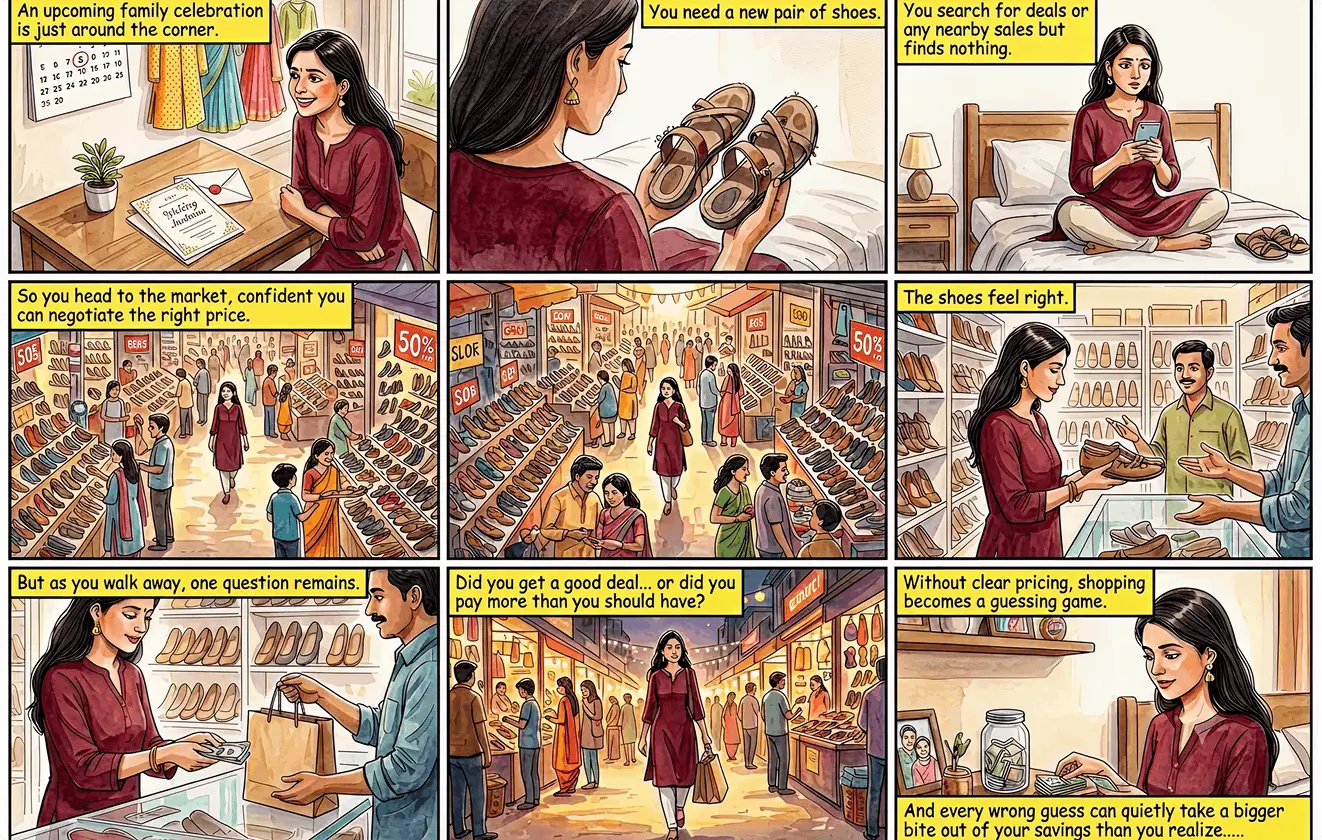
Image: Visualizing the Core Pain Point
2.
Even when a deal is discovered through a chat, flyer, or word of mouth, there is no reliable way to confirm if it’s genuine, if the price is fair, or if the seller can be trusted.
The element of trust is still completely missing.
3.
Group shopping is a part of our core users' shopping behavior, but they avoid doing it with larger groups and prefer doing it with family.
This is because it comes with its own major challenges: group coordination and tracking everyone's interest.
Actually, group shopping is good for a seller’s business as it increases sales, plus it also helps users get better deals.
But in reality, it is limited to closest friends and family, making it a rare event.
To complete the shopping journey, validation is a massive part; either asking a friend before making a purchase, or telling a friend after a purchase.
4.
Valuable purchase experiences, local seller discoveries, and community advice get shared in WhatsApp chats and forgotten within hours.
There is no way to search for them, revisit them, or build on them over time. The information exists, but it is effectively invisible.
product CONTEXT
NARI is a two-sided platform that connects women with verified local sellers. This case study focuses on the user experience/buyer side.
The seller experience, including verification, deal management, and redemption confirmation, is covered only as supporting context and remains outside the primary scope of this project.
The Seller Side context
Trust depends on a verified seller network.
Sellers publish local deals, maintain accurate offer information, and confirm redemptions through the platform.
This ensures that ratings, redemption counts, and other trust indicators are based on real transactions rather than unverified activity.
While the seller experience is outside the scope of this case study, it plays a critical supporting role.
The user-facing/buyers experience relies on this foundation to make deals credible and trust signals meaningful.

Image: Core Product Hypothesis
Solutions
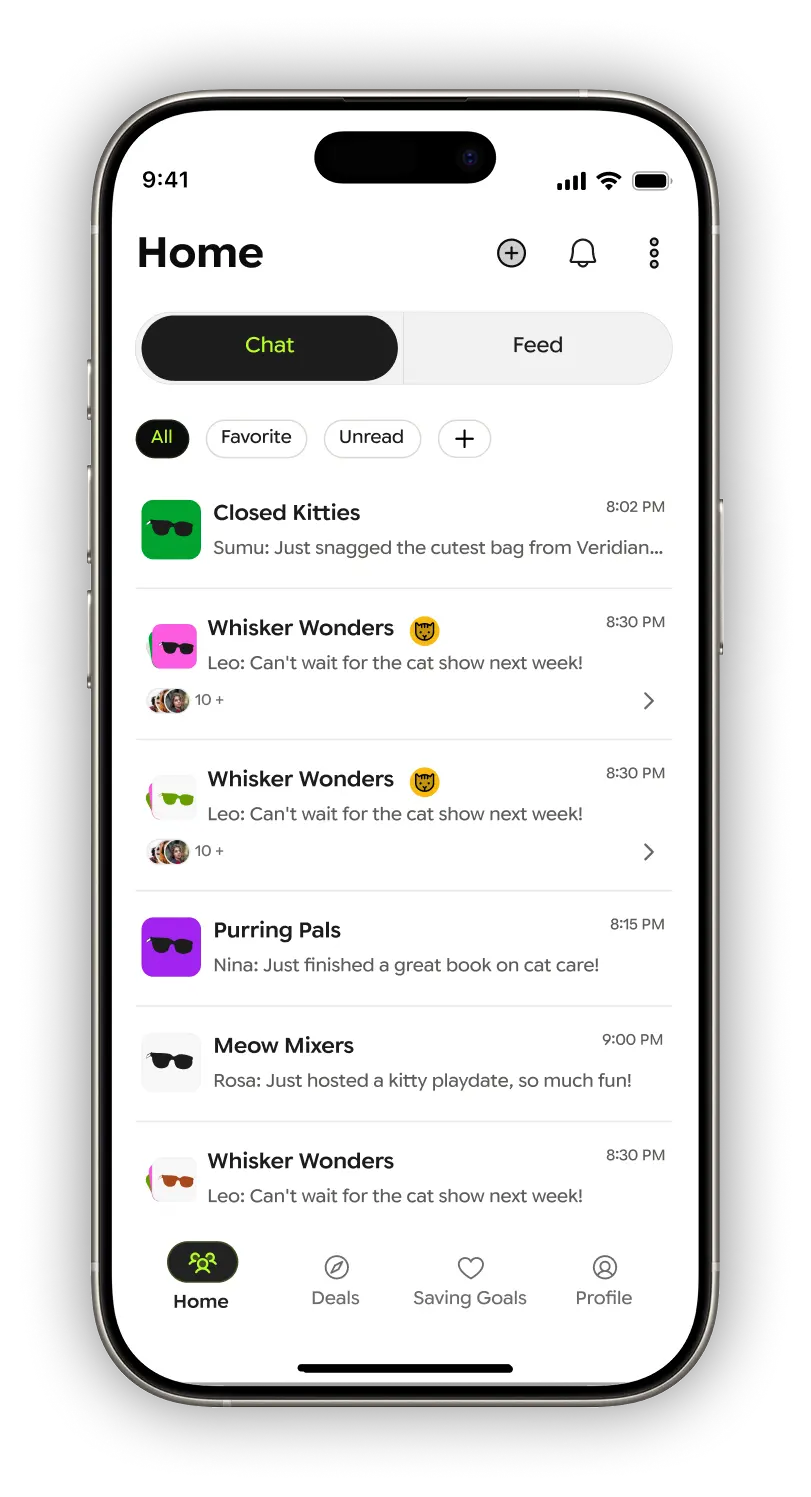
My community screen
Users love sharing their purchases, seller discoveries, shopping tips, and questions with their networks.
Instead of letting these conversations scatter across external apps, bringing a dedicated community space right inside the platform is the most natural solution and a community feed does exactly that.
But why a community feed? The answer is simple:
1.
A persistent, scrollable space: It creates a permanent home for community knowledge so good recommendations don't vanish.
2.
Natural and conversational posts: It shows what was bought, what it cost, why it was worth it, and if others should buy it too.
3.
No chat clutter: Important information never gets buried inside a busy, fast-moving group chat discussion.
4.
Closed-loop validation: It completes the trust cycle because it works entirely within private, mutual, and safe group spaces.
5.
Familiar mental models (Jakob’s Law): Users spend most of their time on other apps (like Facebook). By building a familiar, scrollable feed, they instantly know how to interact with it.

Video: My community screen
How it works
The feed is strictly limited to known group members, making it a close, trusted circle of peers, friends, and family.
Instead of lost text messages, women can share real purchase experiences, local seller recommendations, or drop open questions.
Getting appreciation through likes and engaging through comments keeps the community tight, makes everyone feel connected, and gives their insights a real sense of importance.
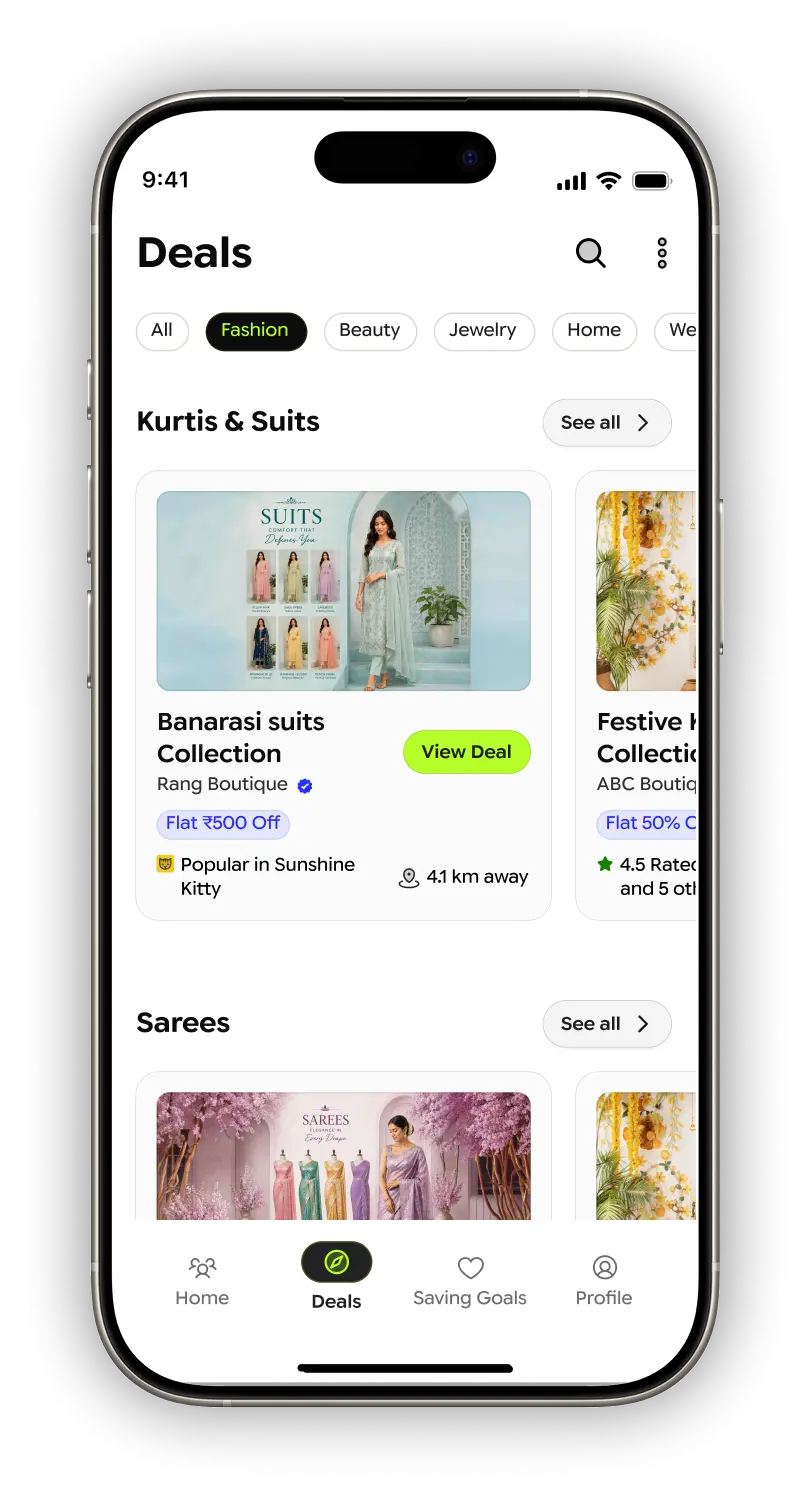
Finding deals and discounts through a structured experience.
Deals are the sales or discount offers created by a particular shopkeeper to drive more storefront sales and keep customers coming back.
Today, women find these deals scattered across WhatsApp forwards, Instagram stories, paper flyers, and word of mouth.
This fragmentation causes customers to miss out on value-driven shopping opportunities, while local sellers fail to reach potential consumers.
But why a deals tab is effective:
1.
A single, organized destination: It collects fragmented sales and offers from local market sellers, turning chaotic discovery into a structured experience.
2.
Searchable and permanent records: It provides an easy way to browse and revisit active offers, ensuring a deal found on Tuesday isn't completely lost by Thursday.
3.
No reach limitations: It eliminates the restricted visibility of private group chats or short-lived social media stories, maximizing exposure for local merchants.
4.
Value-driven shopping opportunities: It protects customers from missing nearby savings and staying out of the knowledge loop, while helping sellers secure potential consumers.
5.
Instant, friction-free redemption: It closes the loop by allowing users to claim digital coupons directly from the app and redeem them seamlessly at the physical storefront.
Video: Deal Discovery screen
How it works
Consolidated Local Sales: The tab acts as a unified inventory for active discounts offered by trusted neighborhood merchants and market sellers.
Claiming the Offer: Instead of relying on word of mouth or unverified flyers, users instantly grab a secure coupon directly from the deal card inside the app.
In-Store Validation: Shoppers present the claimed coupon when visiting the shop, unlocking guaranteed savings and driving predictable foot traffic back to local businesses.
How discovery is structured
The first versions of the Deals Tab included both a trending section and a category structure running alongside each other.
But failed because of conflicting mental models:
1.
Trend-Driven vs. Need-Driven: Trending sections surface what is popular at the moment. However, for our core users, the shopping entry point is naturally need-driven or occasion-driven rather than trend-driven.
2.
Unnecessary Cognitive Load: Maintaining both structures as equal entry points forced users to decide how to browse before deciding what they actually wanted, adding unnecessary complexity without improving the actual discovery yield.
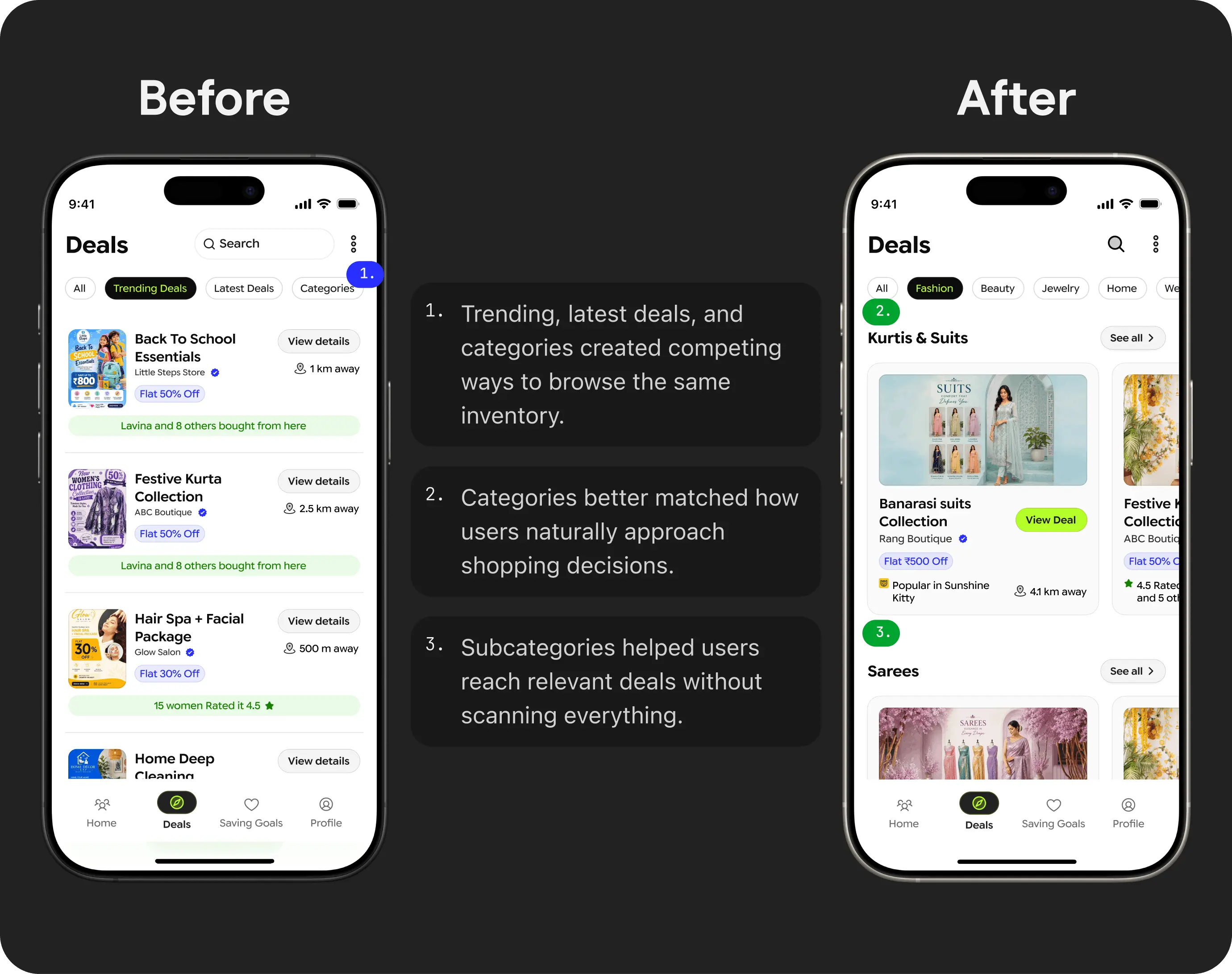
Image: Evolution of deal discovery screen
The Pivot:
So I completely removed the trending sections and established a clear, category-first navigation hierarchy.
Inside each major category, deals are organized into specific subcategories: such as Sarees or Kurtis & Suits under Fashion.
This structural change allows users to head straight toward the specific need that brought them to the platform, skipping the friction of scanning an unorganized inventory.
Outcome
Discovery shifted from popularity-driven browsing to need-driven exploration, reducing decision friction and creating a clearer path into the deal inventory.
Building Trust over Deals Through the Deal Page
Each deal page combines pricing, validity, seller information, ratings, redemptions, community experiences, and a seller note to maintain transparency and help users make confident decisions.
Trust on the deal page is structured in two separate layers:
1.
The first is quantitative: It displays total claims, completed redemptions, and an overall rating collected automatically after each redemption.
2.
The second is qualitative: It features community posts tagged to the deal by women, showing real shopping experiences from those who visited the seller, explained what they bought, and shared whether it was worth it.
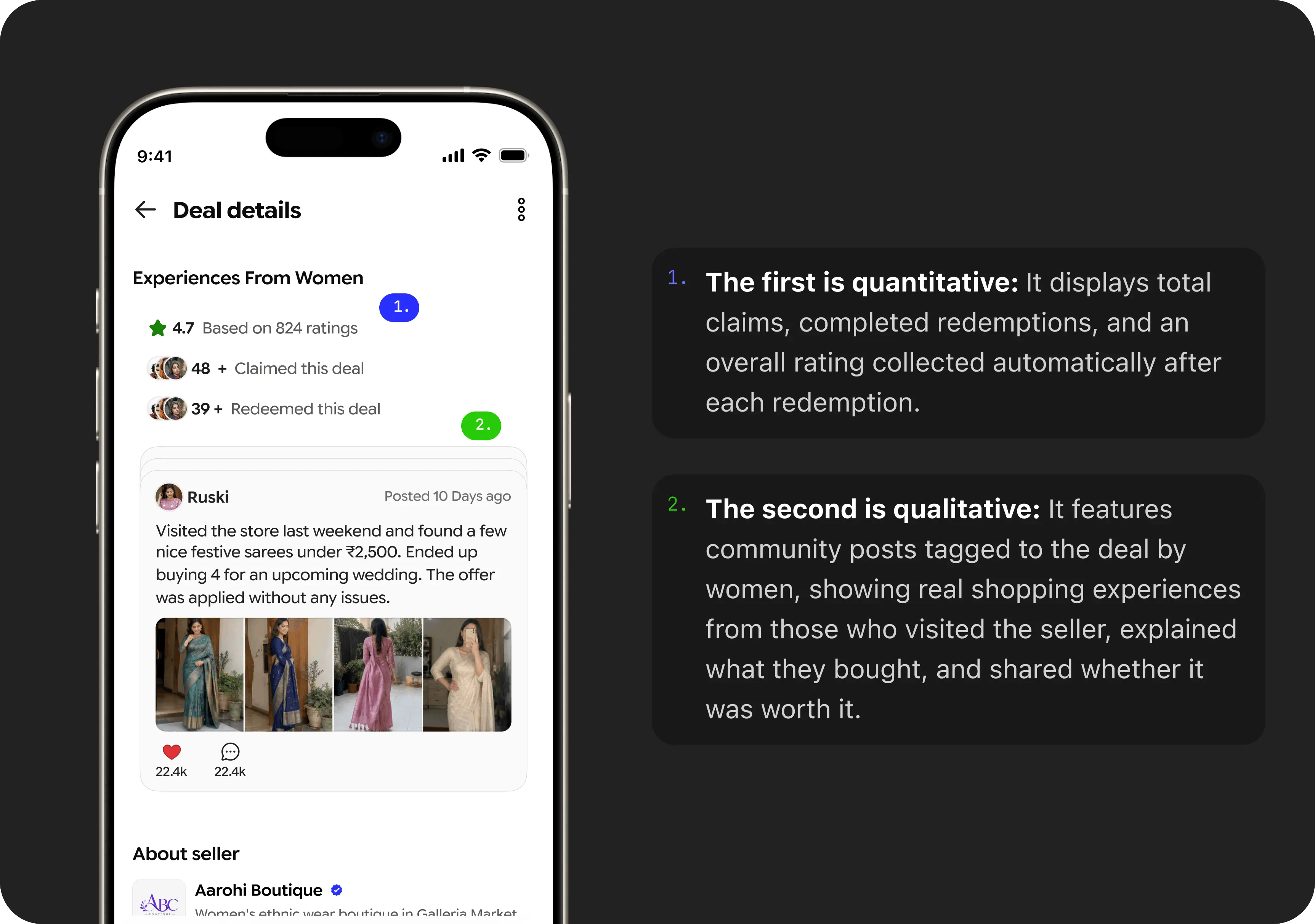
Image: Evolution of deal discovery screen
The UX Hurdle: Avoiding a Single Path for Trust:
Most people who redeem a deal will not take the time to write a full community post.
If trust accumulation depends entirely on voluntary posting, popular deals will receive rich data while smaller or newer deals receive none, limiting the platform's overall credibility.
To solve this, ratings and community posts are deliberately kept as two separate systems with distinct purposes:
Ratings (Quantitative): Collected through a lightweight, one-tap screen immediately after redemption. It requires a single action and zero writing, ensuring trust signals accumulate automatically from every single transaction.
Community Posts (Qualitative): Remain an entirely optional social behavior for users who want to share a deeper, conversational experience.
Bridging the Convenience Gap to Make Group Buying Common Practice.
For group shopping, it requires pooling interest from people in the same network who want the same thing at the same time, which is a complete nightmare in itself.
The question arises: How can we make it easy for users to pool interest for group shopping by removing hesitation and extra effort?
So the solution:
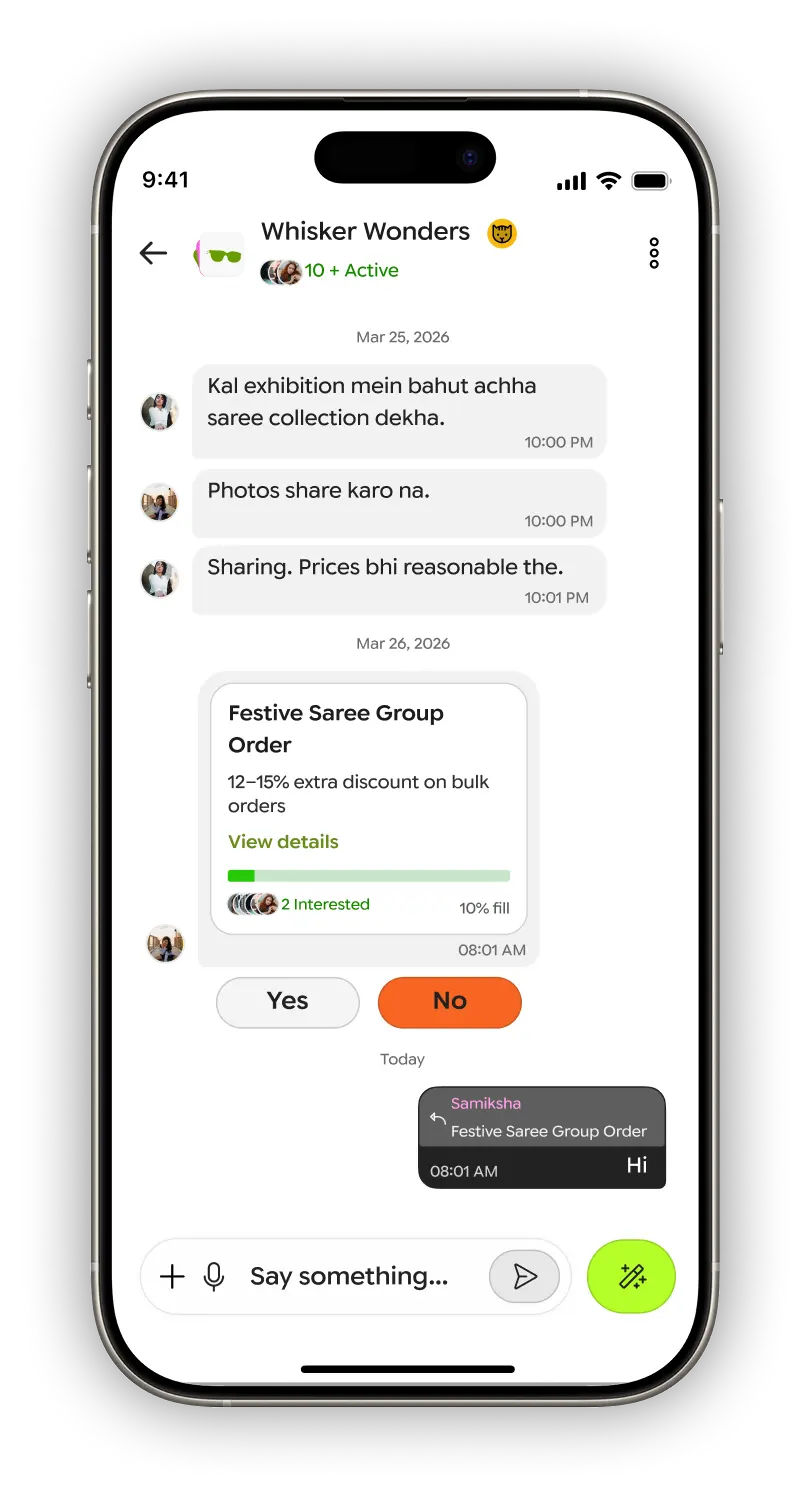
When a woman finds a deal, a group saving opportunity appears right on the deal details page as Share Pool with Group Card.
This unlocks an extra discount based on a set number of members joining the deal (set by the seller), giving everyone an equal opportunity to save.
Video: sharing pool with group
why
1.
Easy to share as an interest pool card: With a single tap from the deal page, users can share it directly inside their groups, allowing everyone to show interest with a simple vote of "yes" or "no."
2.
Clear transparency: It shows clear details about the deal, clearing all doubts on its own without needing anyone else to explain.
3.
Progress tracking: A clear indicator shows how much is filled and how much is needed to unlock the full discount.
Closing Reflection:
This project started as a challenge in deal discovery and grew into something bigger: a design that captures what women already do and gives it a proper structure.
NARI doesn't ask women to change how they shop. It takes habits that already exist, sharing deals, asking friends, and buying together, and gives them a reliable place to live.
The core shift is simple: instead of creating new behaviors, the platform anchors the ones already happening inside WhatsApp groups and neighborhood conversations.
Every design decision came from a real human constraint, not a technical one:
Most users won't write reviews, so ratings were made automatic. One tap after redemption, no writing required.
Women don't browse deals by keyword, so navigation was built around categories and occasions, not a search bar or trending section.
Group buying falls apart when coordination is hard, so the interest pool card reduced it to a single yes-or-no decision, visible to everyone in the group at once.
The result is a platform where trust builds itself through real transactions, discovery matches how women naturally shop, and group savings become easy enough to actually happen.